
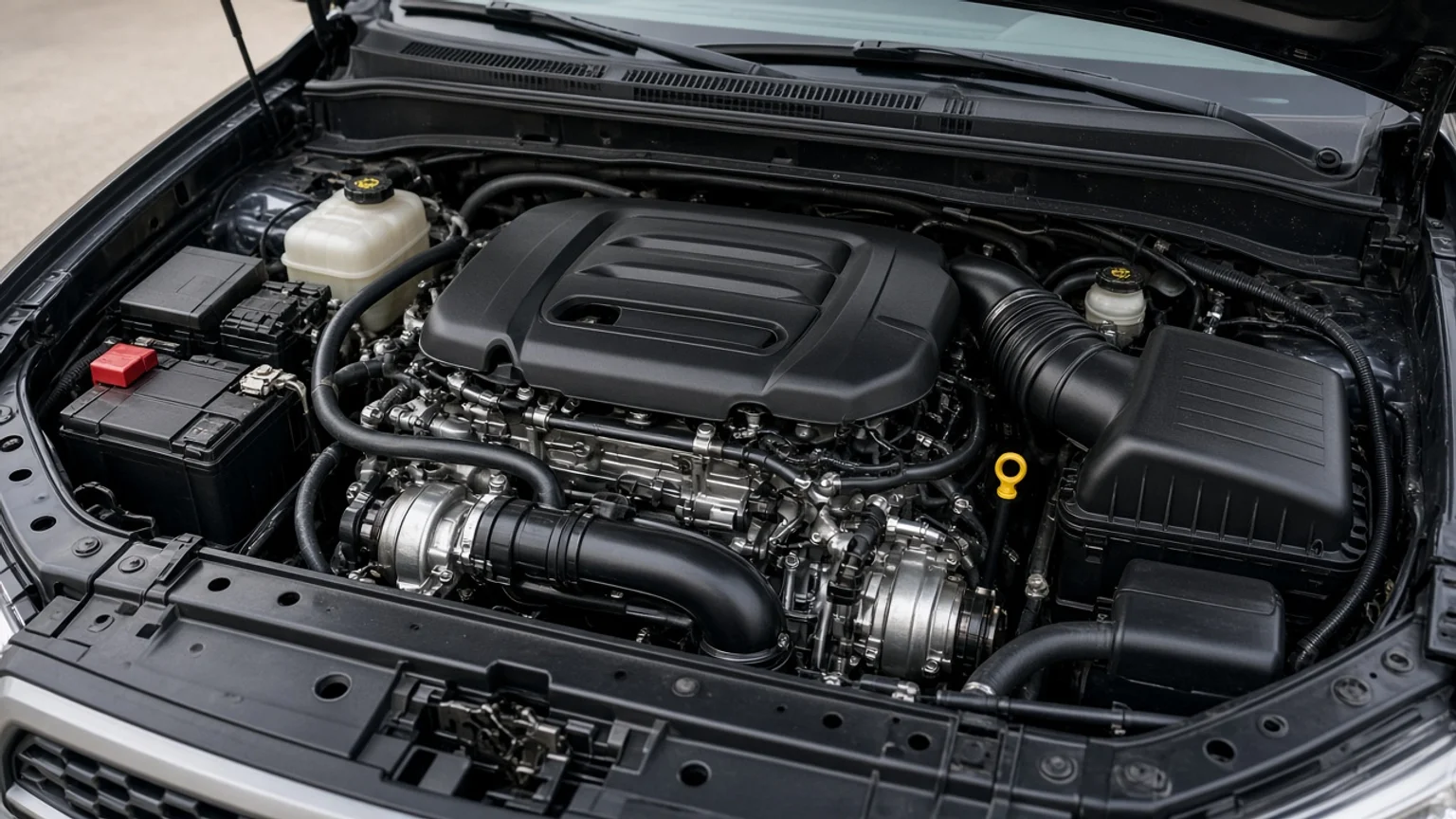
The 2.7 EcoBoost years to avoid are 2015-2017 and 2021-2022. The 2021-2022 engines are covered by NHTSA recall 24V-635, because their intake valves may break and cause engine failure (accessed October 27, 2026). The 2015-2017 engines have the most engine complaints in our NHTSA count (57 of 108) and Ford bulletins for oil pan leaks and, on some Edge and Fusion models, oil burning. Ford's twin-turbo 2.7-liter V6 arrived in the 2015 F-150 and got a second-generation version for 2018.
Related: Ford F-150 years to avoid, Ford Bronco years to avoid, Ford Edge years to avoid, Lincoln Nautilus years to avoid.
At a glance
- Worst years
- 2015
- 2016
- 2017
- 2021
- 2022
- Best years
- 2019, 2020, 2023 (with the caveats below)
- Top failure
- broken intake valves on 2021-2022 engines (NHTSA recall 24V-635)
- Always do before buying
- run the VIN through NHTSA's recall checker and confirm 24V-635 is complete, check under the engine for oil pan leaks and listen to a cold start
How we rated the best and worst 2.7 EcoBoost years
The worst 2.7 EcoBoost years are 2015-2017 and 2021-2022. Because the 2.7 EcoBoost is an engine and not a vehicle, we built the counts ourselves from NHTSA’s raw data, vehicle by vehicle, and then read the complaints to see what owners were reporting.
- Complaints: we counted unique owner complaints in NHTSA’s complaint flat file (FLAT_CMPL, downloaded October 27, 2026) that are filed under an engine component (exhaust excluded) for the F-150, Bronco, Edge, Fusion, Lincoln MKX, Nautilus and Continental in years offered with the 2.7L. Every one of these was also sold with other engines, so we only counted complaints whose text names the 2.7. That gives small numbers and undercounts the real total, so read them as a guide to which years owners complain about most.
- Recalls: we counted the NHTSA recall campaigns that name the 2.7L and cover an engine defect, using NHTSA’s recalls API (accessed October 27, 2026).
- Service bulletins: we read the Ford technical service bulletins and special service messages filed with NHTSA in its TSB data files (downloaded October 27, 2026), with links to the bulletin PDFs on static.nhtsa.gov where NHTSA publishes one.
Newer model years have had less time on the road to collect complaints. Our years to avoid methodology explains how we weigh volume, severity and mileage at failure.
| 2.7 EcoBoost Generation | Best 2.7 EcoBoost Years | Worst 2.7 EcoBoost Years |
|---|---|---|
| First generation (2015-2017 F-150) | None stand out | 2015, 2016, 2017 |
| Second generation (2018 F-150 onward) | 2019, 2020, 2023 | 2021, 2022 |
Every 2.7 EcoBoost model year ranked
Complaint counts are 2.7 engine complaints from NHTSA’s complaint flat file, scoped as described above (downloaded October 27, 2026). Recall counts are the NHTSA engine recall campaigns that name the 2.7L for that model year (accessed October 27, 2026).
| Model Year | NHTSA 2.7 Engine Complaints | NHTSA Engine Recall Campaigns | Verdict | Notes |
|---|---|---|---|---|
| 2015 | 14 | 0 | Avoid | First year; oil pan leak bulletin 23-2083; replacement short blocks converted to a belt-driven oil pump (SSM 49221) |
| 2016 | 21 | 0 | Avoid | Oil pan leak bulletin 23-2083; Edge and MKX oil burning bulletin 19-2243 |
| 2017 | 22 | 0 | Avoid | Most complaints of any year; 9 stall or power-loss mentions; Edge, Fusion, MKX, MKZ and Continental oil burning bulletin 19-2243 |
| 2018 | 13 | 0 | OK/Mixed | Second-generation engine in the F-150; oil pan leak bulletin 19-2189 |
| 2019 | 8 | 0 | Best | Few complaints; oil pan bulletin 19-2189 covers trucks built on or before May 21, 2019 |
| 2020 | 1 | 0 | Best | Fewest complaints of any year; no engine recall |
| 2021 | 18 | 1 | Avoid | Intake valve recall 24V-635; 10 of the complaints are on the new Bronco |
| 2022 | 7 | 1 | Avoid | Intake valve recall 24V-635 |
| 2023 | 3 | 0 | Best | Few complaints; no engine recall; check cam phaser bulletin SSM 51542 |
| 2024 | 1 | 0 | Too new | Too little time on the road to judge |
Across all years we counted 108 2.7 engine complaints: 80 on the F-150, 16 on the Bronco, 6 on the Edge, 5 on the Fusion and 1 on the Nautilus. None is flagged by the owner as involving a fire, and 1 as involving a crash.
Most common 2.7 EcoBoost problems
The 2.7 EcoBoost problems that show up most in NHTSA data and Ford’s own bulletins are broken intake valves on 2021-2022 engines, oil pan leaks, oil burning on some 2016-2017 cars and crossovers, and cam phaser rattle.
1. Broken intake valves (2021-2022)
NHTSA recall 24V-635 (Ford recall 24S55) covers certain 2021-2022 Bronco, F-150, Edge, Explorer, Lincoln Nautilus and Lincoln Aviator with the 2.7L or 3.0L Nano EcoBoost. NHTSA’s summary says “the engine intake valves may break while driving, which can result in engine failure and a loss of drive power.” Dealers run an engine cycle test and replace the engine as needed, free of charge. Owner letters were mailed July 3, 2025 (NHTSA, accessed October 27, 2026). Of the 2021 complaints we counted, 10 mention a valve and 9 mention engine failure or replacement.
Buyer takeaway: on a 2021-2022 with the 2.7, get proof that 24V-635 was done, and ask whether the engine was replaced.
2. Oil pan leaks (2015-2019 F-150)
Oil pan complaints number 11 in our count, all on 2015-2019 models. Ford bulletin 23-2083 (March 2023) covers 2015-2017 F-150s with the 2.7L that may leak oil from the oil pan RTV seal, and replaces the pan with a later-style pan. Bulletin 19-2189 (August 2019) covers 2018-2019 F-150s built on or before May 21, 2019, and replaces the pan with one that has a press-in-place gasket.
3. Oil burning and smoke (2016-2017 Edge, Fusion and Lincolns)
Ford bulletin 19-2243 (August 2019) covers 2016-2017 Edge and MKX and 2017 Continental, Fusion and MKZ with the 2.7L or 3.0L built from April 1, 2016 through January 1, 2017. Ford says they may show white or blue exhaust smoke, a rough idle at operating temperature or after a hot restart, a check engine light and oil consumption of 1 quart in less than 3,000 miles. Ford says this may be due to the valve guides, and the fix is new cylinder heads. Oil consumption or smoke mentions number 10 in our complaint count.
4. Cam phaser rattle and engine noise
Ford has bulletins for a 2-5 second rattle from the front of the engine on a cold start after sitting 6 hours or more, caused by stuck parts inside the variable cam timing unit: 22-2376 (October 2022) for 2019-2022 Edge and Nautilus, and SSM 51542 (April 2023) for 2020-2023 F-150 and 2021-2023 Bronco. A separate message, SSM 51665 (May 2023), covers a thump or knock from the left cylinder head on some 2021-2023 2.7L and 3.0L engines, which Ford says “does not affect vehicle durability and will not get worse over time.” On 2015-2016 Edge and 2016 MKX built October 29, 2015 through April 1, 2016, bulletin 16-0094 (July 2016, NHTSA file 10091201) covers a knocking or tapping noise from a loose check valve in the fuel feed tube.
5. Replacement short blocks on 2015-2017 engines
Ford’s SSM 49221 (September 2020) tells technicians that when a replacement short block goes into a 2015-2017 vehicle with the 2.7L or 3.0L, the engine must be converted to a belt-driven oil pump, with new camshafts and related parts.
Which 2.7 EcoBoost years should you avoid
The 2.7 EcoBoost years to avoid are 2015-2017 and 2021-2022. The 2015-2017 engines have the most complaints (57 of 108) plus the oil pan and oil burning bulletins. The 2021-2022 engines have the intake valve recall, which can mean engine failure (NHTSA, accessed October 27, 2026).
| 2.7 EcoBoost Generation | Model Years | Verdict | Main Issues |
|---|---|---|---|
| First generation | 2015, 2016, 2017 | Worst: Avoid | Oil pan leaks, oil burning on some cars and crossovers, stalling or power loss |
| Second generation | 2021, 2022 | Worst: Avoid | Broken intake valves (recall 24V-635), cam phaser rattle |
Worst 2.7 EcoBoost years: 2015, 2016, 2017, 2021, 2022
First-generation 2.7 EcoBoost (2015-2017)
The 2017 model year has the most complaints of any year (22), and stalling or power loss mentions are highest on that year (9). Check under the engine for oil leaks on any 2015-2017 F-150.
Second-generation 2.7 EcoBoost (2018 onward)
For the 2018 F-150, Ford introduced an all-new second-generation 2.7 EcoBoost with dual port and direct injection, paired with a 10-speed automatic (Ford’s 2017 announcement, republished by Automotive World, accessed October 27, 2026). Complaints dropped on the 2018-2020, then rose on the 2021, the first Bronco year and one of the intake valve recall years.
What are the best 2.7 EcoBoost years to buy
The best 2.7 EcoBoost years to buy are 2019, 2020 and 2023. They have the fewest complaints in our data and are outside the 24V-635 intake valve recall.
| Best 2.7 EcoBoost Year | Why It's a Strong Buy |
|---|---|
| 2019 | 8 engine complaints; no engine recall; check the oil pan bulletin on early builds |
| 2020 | 1 engine complaint, the fewest of any year; no engine recall |
| 2023 | 3 engine complaints; no engine recall |
Most reliable 2.7 EcoBoost years: 2019, 2020, 2023
Our 2.7 counts are small because many owners don’t name the engine, so a low count here is weaker evidence than it would be for a bigger sample. The 2023 model year has also had less time on the road.
2.7 EcoBoost years to avoid by vehicle
These are the patterns in our complaint counts and Ford’s bulletins (NHTSA, accessed October 27, 2026):
- Ford F-150: the 2016 (20 complaints) and 2017 (15) lead; 2021-2022 trucks need recall 24V-635 checked. See Ford F-150 years to avoid.
- Ford Bronco: the 2021 (10) and 2022 (4) are the years to check, both inside the 24V-635 recall. See Ford Bronco years to avoid.
- Ford Edge and Lincoln MKX: check the 2016-2017 oil burning bulletin and the 2021-2022 recall. See Ford Edge and Lincoln MKX.
- Ford Fusion: all 5 complaints are on the 2017, which is covered by the oil burning bulletin. See Ford Fusion years to avoid.
- Lincoln Nautilus: check the 2021-2022 recall and the cam phaser bulletin. See Lincoln Nautilus years to avoid.
2.7 EcoBoost pre-purchase checklist
Before you buy a used vehicle with the 2.7 EcoBoost, check:
- Run the VIN on NHTSA’s recall checker: 24V-635 should show as complete on 2021-2022 models.
- Look under the engine for oil around the oil pan, especially on 2015-2019 F-150s.
- Listen to a true cold start: let it sit for at least 6 hours and listen for a rattle in the first few seconds.
- Watch the exhaust: white or blue smoke at idle is a warning sign on 2016-2017 Edge, Fusion and Lincoln models.
- Ask about engine or short block replacement and get the invoices. Get a pre-purchase inspection.
Better alternatives to consider
If the 2.7 EcoBoost vehicle in your budget is a 2015-2017 or 2021-2022, or the recall history is unclear, consider these instead:
- 3.5 EcoBoost - the larger twin-turbo V6 in the F-150, with its own years to check
- GM 5.3 V8 - the V8 in the Silverado and Sierra
- Toyota Tundra - a full-size pickup rival
- Toyota 4Runner - an off-road SUV alternative to the Bronco
Is the 2.7 EcoBoost a good engine
Yes, in the right year. The 2019-2020 and 2023 engines have few complaints in our data and no engine recall. Skip the 2015-2017 engines unless the oil pan and service history check out, and only buy a 2021-2022 with proof that recall 24V-635 was done. Our counts are small raw complaint totals, not failure rates, so treat them as a guide.
Frequently asked questions
What are the worst 2.7 EcoBoost years
The worst 2.7 EcoBoost years are 2015-2017 and 2021-2022. The 2021-2022 engines are under recall 24V-635 for intake valves that may break and cause engine failure, and the 2015-2017 engines have the most complaints in our NHTSA count (accessed October 27, 2026).
What are the best 2.7 EcoBoost years
The best 2.7 EcoBoost years are 2019, 2020 and 2023. They have the fewest complaints in our data and no engine recall.
Is there a recall on the 2.7 EcoBoost
Yes. NHTSA recall 24V-635 (Ford 24S55) covers certain 2021-2022 Bronco, F-150, Edge, Explorer, Nautilus and Aviator with the 2.7L or 3.0L. Dealers test the engine and replace it if needed.
Does the 2.7 EcoBoost have oil pan leaks
Ford bulletins 23-2083 and 19-2189 cover oil pan RTV seal leaks on 2015-2017 F-150s and 2018-2019 F-150s built on or before May 21, 2019. The fix is a later-style pan.