
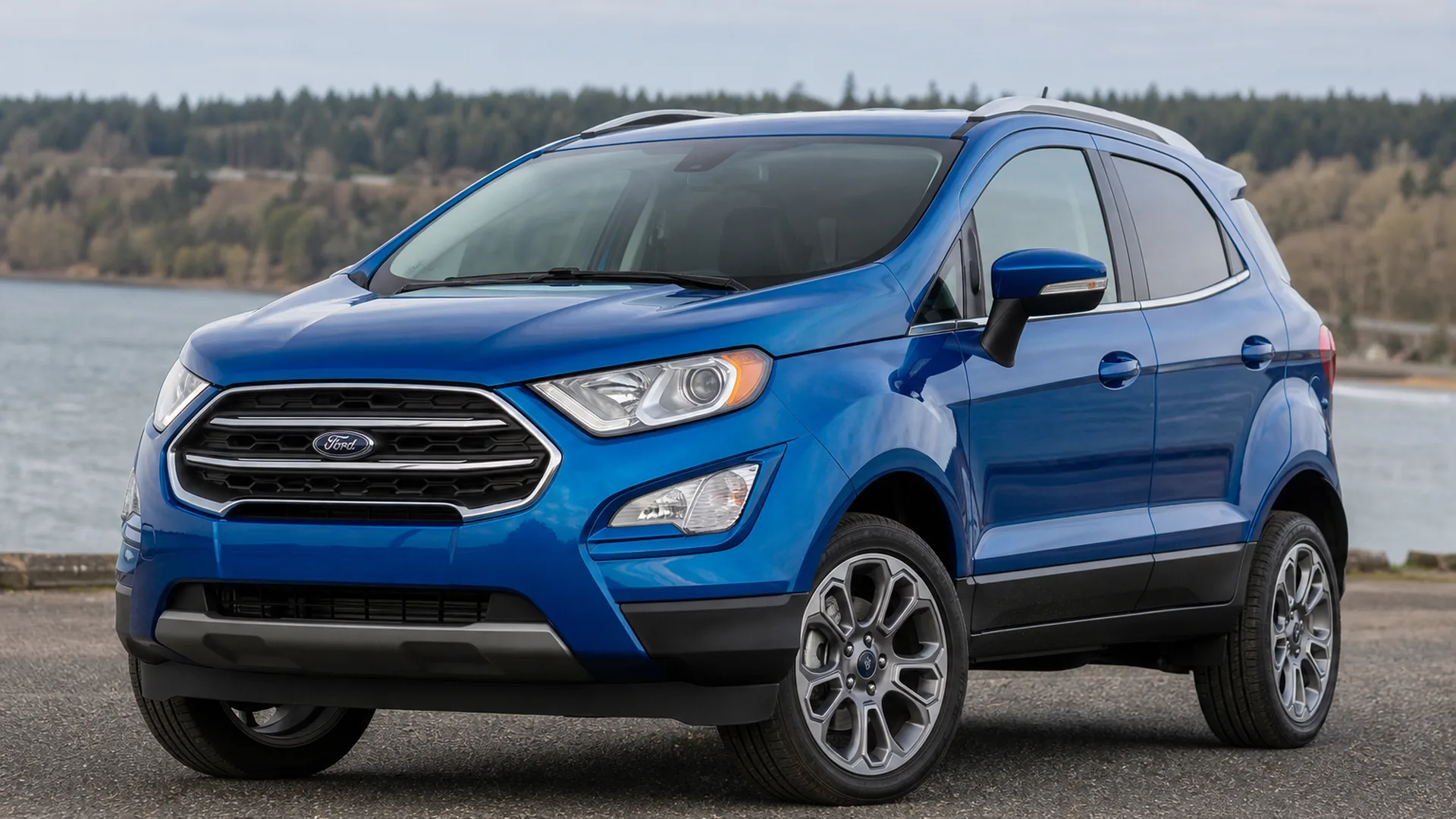
The Ford EcoSport entered the U.S. market in 2018 as an affordable subcompact SUV aimed squarely at city drivers and first-time buyers. With its compact footprint, available all-wheel drive, and budget-friendly price tag, Ford positioned it as the perfect urban runabout. The EcoSport had already proven itself globally since 2003, so American buyers expected a reliable, practical little crossover.
What they got instead was a vehicle plagued by catastrophic engine failures, troublesome transmissions, and a string of safety recalls. If you’re considering a used EcoSport, you need to know exactly which years will drain your wallet—and which ones might actually serve you well. We’ll show you the Ford EcoSport years to avoid, identify the safer options, and point you toward better alternatives in this price range.
How we rated the best and worst Ford EcoSport years
We pulled data from NHTSA‘s complaint database and recall records, focusing on the oil pump belt failures that devastated many 2018–2019 owners. CarComplaints.com provided year-by-year complaint volumes, while Consumer Reports gave us hard reliability scores (spoiler: the EcoSport scored a dismal 29 out of 100, compared to competitors averaging 75+).
RepairPal contributed repair frequency and cost estimates—those engine replacements run $5,000 to $9,000 when the oil pump belt snaps. We cross-referenced owner forums and mechanic feedback to separate isolated incidents from systemic problems. The PowerShift dual-clutch transmission (used from 2013–2017 globally) received special attention because it shares the same fundamental flaws that plagued the Focus and Fiesta. Finally, we compared IIHS and NHTSA safety ratings against rival subcompact SUVs to see where the EcoSport actually stands.
Most Common Ford EcoSport Problems
1. When Engines Quit Without Warning
The 1.0L EcoBoost three-cylinder sounds efficient on paper, but it hides a critical design flaw. Inside that tiny engine, an oil pump drive belt keeps everything lubricated. When the belt’s tensioner fractures—which happened to hundreds of 2018–2019 EcoSports—the belt snaps, oil pressure drops to zero, and the engine seizes within seconds. You’ll get a warning light and maybe thirty seconds to pull over before permanent damage occurs.
Ford issued a recall covering 2018–2022 models, but not before many owners faced $6,000+ repair bills. Some engines failed at under 20,000 miles. The wet timing belt (which runs in engine oil rather than being externally mounted) adds another headache—premature wear can destroy internal components if you ignore maintenance intervals. Coolant leaks plagued earlier EcoBoost versions too, sometimes cracking cylinder heads when overheating went unnoticed.
2. Transmissions That Shudder and Fail
If you’re looking at 2013–2017 EcoSports sold outside the U.S., run the other direction from anything with Ford’s PowerShift dual-clutch automatic. This transmission was notorious in the Focus and Fiesta, and it’s just as problematic here. Owners report violent shuddering during acceleration, clunking sounds when shifting, and complete failures at low mileage. Repair costs often exceed the vehicle’s value.
Ford finally ditched the PowerShift for a conventional six-speed automatic in 2018, which immediately improved reliability. The new transmission isn’t perfect—some owners still mention jerky shifts or hesitation—but software updates or fluid changes typically fix those quirks. Just steer clear of any dual-clutch model unless you enjoy surprise four-figure repair bills.
3. Electrical Gremlins You Can’t Predict
The 2014 EcoSport earned a reputation for failing infotainment systems and touchscreens that randomly reset or go completely dark. Random warning lights (ABS, traction control, check engine) pop up with no apparent cause, usually traced to weak batteries or faulty sensors. The 2018 model introduced a bizarre door lock glitch where power locks stopped working in wet weather, forcing owners to manually secure their vehicles.
Most electrical issues fall into the “annoying but not dangerous” category—flickering cabin lights, backup camera freezes, battery drain overnight. Keep the battery fresh and software updated, and you’ll avoid many of these problems. Still, diagnosing electrical faults gets expensive fast when sensors start failing randomly.
4. Brakes That Grind and Grab
Brake complaints spike for certain years, particularly 2018 models fitted with cheap brake pads and rotors. Owners describe screeching, grinding sounds even on low-mileage vehicles, plus a handful of scary incidents where brakes felt like they momentarily locked up. The 2015 EcoSport saw premature brake wear across the board—pads and rotors needed replacement far sooner than normal.
The suspension isn’t much better. Early models (2014–2015) delivered a harsh ride with rattles over bumps, often caused by worn shocks or failing bushings. The EcoSport’s tall stance and short wheelbase make it naturally bouncy, so you need to differentiate between design characteristics and actual component failures during test drives.
5. Climate Control That Gives Up
Air conditioning problems aren’t universal, but 2014–2016 owners frequently report weak cooling at idle. The A/C blows warm air in stop-and-go traffic until you rev the engine—sometimes it’s just the small displacement reducing compressor output, other times it’s a failing compressor or clogged condenser. Blower motor failures have popped up too, leaving you with zero airflow. Blend door actuators fail and create temperature control issues (cold air blasting when you want heat, or vice versa).
Regular maintenance helps—clean those filters and check refrigerant levels annually. Repairs range from simple recharges to thousand-dollar compressor replacements, depending on what actually failed.
Recalls That Tell the Real Story
Beyond the oil pump belt recall, Ford issued a safety recall for 2019 seat backs that weren’t properly welded and could collapse in a crash. Another recall addressed rear brake linings to improve stopping performance. If you’re shopping for a used EcoSport, check the VIN for open recalls immediately—you want proof that the engine belt fix, seat frame repairs, and brake updates were completed.
NHTSA gave the EcoSport four stars overall (five for side impact, but only three for rollover resistance). That’s average for the class, not impressive. What really hurts is the lack of modern driver aids—automatic emergency braking, lane departure warning, and blind-spot monitoring were either unavailable or optional on most years. Competitors bundle those features as standard equipment.
The Ford EcoSport Years You Should Skip
2014: The Global Disaster Year
The 2014 EcoSport collected more owner complaints than any other model year worldwide. The PowerShift transmission caused constant shuddering and jerking at stops, often failing completely before warranty expired. Infotainment systems froze or died entirely. Braking felt uneven, and random electrical warnings kept owners guessing.
Unless you find a 2014 with documented proof that Ford replaced the transmission and fixed the electronics under warranty, walk away. Even then, you’re gambling on a vehicle with a terrible track record.
2013: First-Year Troubles Multiplied
As the launch year for the second-generation EcoSport, 2013 models showed all the classic signs of rushed development. Transmission failures matched or exceeded 2014 rates. Electrical systems misbehaved constantly—malfunctioning sensors triggered dashboard light shows with no clear cause. Fuel economy fell short of EPA estimates, probably because the transmission couldn’t figure out which gear to use.
The tempting low prices on 2013 EcoSports come with hidden repair costs that quickly erase any savings. There are too many better options in this price bracket to risk it.
2018: America’s Introduction to EcoSport Problems
Ford’s U.S. debut couldn’t have gone worse. The 2018 EcoSport arrived with the oil pump belt flaw fully intact, leading to widespread engine failures. Owners described hearing a rattling noise, seeing the oil pressure warning light, then watching their engines die mid-drive. Dealers quoted $8,000 for engine replacements on vehicles barely out of the factory.
Brake issues compounded the nightmare—squealing, grinding, and reports of brakes momentarily locking up at highway speeds. Door locks failed in rain. The recall didn’t arrive until 2022, leaving early buyers stranded with out-of-pocket repairs.
Even with recalls completed, 2018 models carry the stigma of being the worst U.S. year. Only consider one if it’s heavily discounted, has documented recall completion, and passes a thorough pre-purchase inspection by a trusted mechanic.
2015: The Middle Child Nobody Wanted
The 2015 EcoSport doesn’t get as much attention as the disaster years, but it earned its spot on this list. Premature brake wear plagued owners—pads and rotors needed replacement at half the expected mileage. Fuel system problems cropped up (faulty pumps, clogged injectors) causing rough running and poor performance.
Multiple recalls hint at quality control lapses during production. Maintenance costs run higher than average for 2015 models. It’s marginally better than 2013–2014, but you can do better for similar money.
Best EcoSport Years to Buy
2012: The Final First-Generation Model
If you’re shopping in markets where the original EcoSport was sold, 2012 represents the most refined version of that generation. Ford had a decade to sort out issues, and it shows—virtually zero common complaints appear in used car databases. The simple four-cylinder engines paired with manual or conventional automatics prove durable and easy to maintain.
You’re looking at a vehicle over twelve years old now, so condition matters more than model year. But if you find a well-kept 2012, it’s a reliable choice.
2016–2017: Mid-Cycle Improvements Pay Off
Ford upgraded the PowerShift transmission seals by 2016, significantly reducing failure rates. Many markets got manual transmissions as the standard option, bypassing dual-clutch problems entirely. Owner feedback for these years shows minimal complaints—no widespread engine or transmission issues emerge in the data.
CoPilot’s aggregated reports show zero major complaints for 2016 and 2017 EcoSports. These models predate the U.S. launch, so availability depends on your location, but they represent the sweet spot for reliability if you can find one.
2019: Learning From Mistakes
Mid-2019 production received the updated oil pump belt tensioner that should have been there from the start. Ford’s recall and technical service bulletins covered earlier builds, so engine failure rates dropped dramatically compared to 2018. Safety scores improved slightly, and more driver assistance tech became available as options.
Owners report decent reliability for 2019—the main complaint remains poor fuel economy rather than mechanical failures. Just verify that any 2019 you’re considering had the seat frame recall completed if it was in the affected production batch.
2020–2022: The Final Refined Versions
By 2020, Ford had addressed most EcoSport bugs. Complaint volumes for 2020–2021 are remarkably low—the 2021 model year saw almost no significant reported issues. Updated engine components and the proven six-speed automatic combine for the best reliability the EcoSport ever achieved.
Ford discontinued the EcoSport after 2022, which creates opportunity for buyers. Dealers and private sellers often discount the final model years since the nameplate is dead. Don’t worry about parts support—Ford maintains inventory for discontinued models for many years, and the mechanical bits are shared with other vehicles anyway.
A 2020 or 2021 EcoSport at the right price makes sense as a basic commuter, particularly if you need something compact for urban parking. Just remember it still lags behind most competitors in features and refinement.
Better Choices in the Subcompact SUV Segment
The EcoSport rarely wins comparison tests, and reliability data shows why. If you’re flexible on brand loyalty, several alternatives deliver more dependability and often better value.
Honda HR-V: The Reliability Champion
The 2016–2021 HR-V stands as the class benchmark for dependability. Consumer Reports scored it 41 points higher than the EcoSport in reliability ratings. Owners rave about Honda’s “Magic Seat” system that creates surprisingly flexible cargo space, plus genuinely good fuel economy. A 2017–2019 HR-V had minimal reported issues across the board.
The HR-V isn’t quick or particularly engaging to drive, but it’s economical and virtually trouble-free. Strong resale values mean you’ll pay more upfront, but lower repair costs and better retention offset that premium.
Mazda CX-3 and CX-30: Premium Feel, Solid Reliability
Mazda’s entries bring upscale interiors and sporty handling to the subcompact class. The 2016–2021 CX-3 didn’t sell in huge volumes, but reliability stayed above average with no major problem patterns. The interior feels more expensive than the price suggests, though rear-seat space suffers.
The CX-30 arrived for 2020 as a slightly larger alternative, and Consumer Reports gave it a 75/100 reliability score (versus the EcoSport’s 29/100). A 2019 CX-3 or 2020 CX-30 delivers Mazda’s well-earned reputation for longevity with a more engaging driving experience than most rivals.
Chevrolet Trax and Buick Encore: Underrated Budget Options
These GM twins don’t generate much excitement, but they work well as basic transportation. The Trax earned an 82/100 reliability rating from Consumer Reports—nearly three times the EcoSport’s score. The 2017–2019 model years represent the sweet spot after GM ironed out early issues.
They’re not quick or high-tech, but parts and repairs come cheap thanks to the older platform. If you need simple A-to-B transportation without surprises, a late-2010s Trax or Encore beats a similar-year EcoSport handily.
Toyota C-HR: Bulletproof Reliability in a Quirky Package
Toyota’s C-HR brings the brand’s legendary durability to the subcompact SUV segment. It’s front-wheel-drive only, and the styling won’t appeal to everyone, but reliability is exceptional. NHTSA gave it five stars for safety, and 2018–2020 models show minimal problems in owner reports.
A 2019 or 2020 C-HR delivers Toyota’s reliability with modern safety tech (Toyota Safety Sense comes standard), though you’ll trade the tight rear seat and lack of AWD for that peace of mind.
Subaru Crosstrek: Capability and Dependability
The Crosstrek steps up slightly in size and price, but it’s worth mentioning because reliability ratings crush the EcoSport. Consumer Reports scored it 85/100—nearly perfect. Standard all-wheel drive and better ground clearance make it genuinely capable off pavement.
The 2015–2017 first-generation and 2018–2021 second-generation Crosstreks are all solid choices (skip the 2013 first-year model). You’ll sacrifice a bit of fuel economy compared to front-drive rivals, but you gain ruggedness and a vehicle that’ll likely outlast your loan.
Other Options to Consider
The Hyundai Kona (2018+) offers bold styling and a strong warranty, though reliability sits mid-pack rather than at the top. The Nissan Kicks (2018+) delivers excellent fuel economy and low running costs, but only in front-wheel drive. If you’re willing to go slightly larger, a certified pre-owned Honda CR-V or Toyota RAV4 from the mid-2010s often costs similar money to a newer EcoSport while offering significantly more space and better long-term reliability.
Making Your Decision
The Ford EcoSport can work as budget transportation if you choose the right year and do your homework. Stick to 2016–2017 (if available in your market), 2019, or 2020–2022 models. Run the VIN through NHTSA’s recall database and verify that every recall—especially the engine oil pump belt—has been completed. Get a pre-purchase inspection from an independent mechanic who knows these vehicles.
Even the best EcoSport years trail most competitors in reliability, features, and overall refinement. The HR-V, CX-30, Trax, C-HR, and Crosstrek all offer better long-term ownership experiences for similar money. The EcoSport makes sense only when priced significantly below alternatives or when you specifically need its compact dimensions for urban parking.
Avoid 2013–2015 and 2018 EcoSports completely unless repair records show all major issues have been addressed and the price reflects the risk. The potential savings aren’t worth the headache of transmission replacements or catastrophic engine failures.
A used EcoSport might look like a bargain on the dealer lot, but the wrong model year will cost you thousands in unexpected repairs. In this segment, reliability matters more than brand loyalty—your wallet will thank you for choosing a dependable alternative instead.