
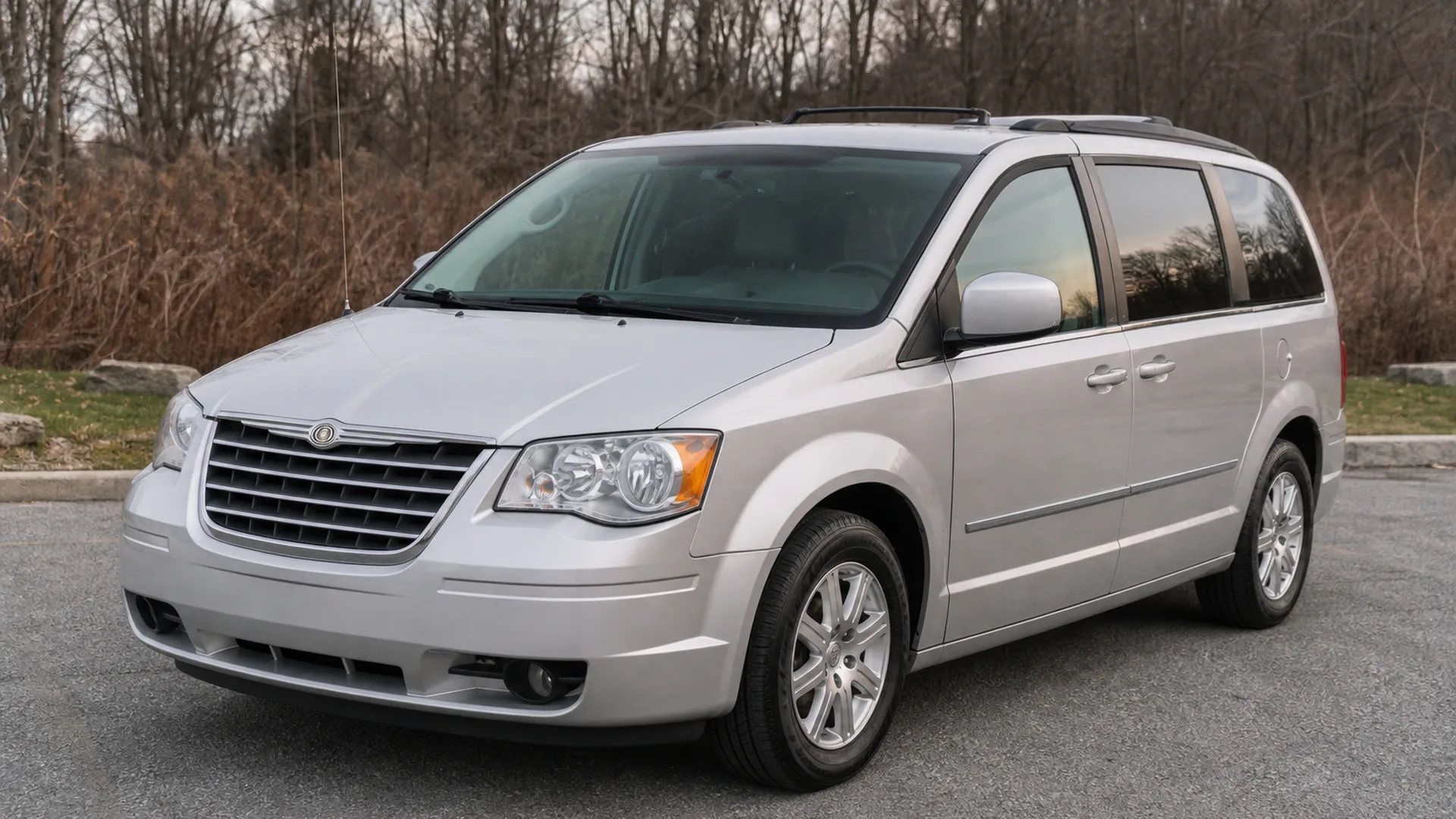
The Chrysler Town & Country spent over two decades hauling families across America, earning a reputation for clever features like Stow ‘n Go seating and genuinely comfortable road trips. When it ended production in 2016, it left behind a legacy of spacious interiors and surprisingly upscale options for a minivan. That’s the good news. The bad news? Some model years earned an equally strong reputation for leaving owners stranded with dead electrical systems, stalling engines, and repair bills that could fund a decent vacation.
If you’re buying the used market for an affordable family hauler, certain Town & Country years should stay off your list entirely. This guide walks you through exactly which Chrysler Town & Country years to avoid, why they fail, and which alternatives might serve your family better without the constant trips to the mechanic.
How we rated the best and worst Chrysler Town & Country years
Our team pulled complaint data directly from the NHTSA database, cross-referenced recall bulletins, and reviewed thousands of owner reports from forums and consumer reliability surveys. We looked specifically at failure patterns across the 2000–2016 production run, focusing on issues that affect safety and cost the most to repair. We also consulted with independent mechanics who specialize in minivans to understand which problems are legitimately dangerous and which are just annoying. The result is a clear picture of which years consistently fail and which years hold up over time.
Most Common Chrysler Town & Country Problems
1. Electrical Failures That Shut Down Everything
Here’s where the Town & Country really earns its bad reputation. The Totally Integrated Power Module (TIPM) is the brain that controls nearly everything electrical in these vans, and when it fails, the results are genuinely scary. Owners report engines shutting off completely at highway speeds, wipers turning on by themselves in clear weather, horns honking randomly in parking lots, and batteries draining overnight even though nothing was left on.
The TIPM sits under the hood and tends to fail most often in 2008, 2010, and 2011 models. Replacing one typically costs between $900 and $1,500, but here’s the frustrating part – the replacement units sometimes fail again within a year or two. Beyond the TIPM, faulty ignition switches and poor wiring connections added to the electrical chaos, occasionally causing actual fires in engine compartments.
2. Engines That Quit Without Warning
The single most dangerous problem in certain Town & Country years is sudden engine stalling while driving. You’re cruising along at 60 mph when the engine simply shuts off – instantly cutting power steering and brake assist. Your dashboard goes dark, the steering wheel becomes incredibly heavy, and stopping safely becomes a real challenge. This happened frequently enough in 2005 and 2008–2012 models that it generated thousands of NHTSA complaints. Sometimes the TIPM was to blame, sometimes ignition components failed, and sometimes the root cause remained a mystery even after multiple repair attempts.
The 3.6L Pentastar V6 that arrived in 2011 brought its own set of headaches. Cylinder heads on this engine proved fragile – misfires in cylinders #2 or #4 became common, often requiring complete cylinder head replacement on one side of the V6. The plastic oil filter housing was another poor design choice; it would crack and leak oil onto hot engine parts, creating both a mess and a fire hazard. Repairs for these engine problems routinely topped $2,500 and sometimes exceeded $5,000 when cylinder heads needed replacing.
3. Transmission Troubles
The 62TE six-speed automatic transmission that Chrysler introduced in 2008 experienced its share of problems, though not quite as widespread as the electrical failures. Hard shifts, slipping, and complete transmission failure showed up most often in 2012 and 2014 models. The 2014 year was particularly bad for cracked flexplates – the metal disc connecting the engine to the transmission – which would crack and cause horrible rattling noises. Some 2014 owners faced complete transmission rebuilds or replacements before hitting 100,000 miles, with repair costs easily reaching $3,500 to $5,500. Earlier four-speed automatics in the early 2000s models had poor reputations too, though the 2004 refresh improved things significantly.
4. Brakes That Wear Out Too Fast
Chrysler apparently undersized the brake hardware on some Chrysler Town & Country models, and 2010 vans suffered the worst. Owners reported needing new brake pads and rotors every 15,000 to 20,000 miles – absurdly short intervals for a vehicle this size. The brakes would develop pulsation and vibration, rotors would warp, and stopping performance would fade in heavy traffic. The problem stemmed from brake components that simply weren’t robust enough for a 4,400-pound van loaded with passengers and cargo. Steering problems usually appeared as a side effect of electrical failures – when the engine died unexpectedly, power steering assist vanished, sometimes locking the steering wheel mid-turn.
5. Climate Control Headaches
Air conditioning failures pop up regularly in owner reports, particularly as these vans age past 80,000 miles. The rear A/C evaporator and lines are common leak points, causing the rear climate zone to blow warm air while the front stays cold. Some owners went through multiple A/C recharges before finally replacing failed components. The 2015 model year showed higher rates of both A/C and heater problems compared to 2016. Heater core failures and blend door malfunctions meant inconsistent cabin temperatures in winter. While rarely safety-critical, fixing a leaking rear evaporator typically costs $800 or more.
6. Technology That Stops Working
All those fancy features that made the Chrysler Town & Country appealing when new became expensive problems when they failed. Power sliding doors are notorious trouble spots – door lock actuators and control modules would fail, causing doors to freeze mid-operation or refuse to unlock. Replacing a failed actuator or track mechanism often runs over $1,000, and some vans needed multiple repairs. The blind spot detection system available on 2009–2012 Touring-L and Limited trims failed with alarming frequency.
The system would shut itself off and trigger warning lights, requiring a roughly $2,000 module replacement to restore function. **Backup camera**s could go dark, Uconnect infotainment systems would freeze and reboot randomly, and in a truly bizarre failure mode, the active head restraints in front seats would sometimes deploy while driving – smacking occupants in the back of the head due to a failed plastic bracket.
Worst Chrysler Town & Country Years to Avoid Completely
2005 – The Electrical Nightmare
Over 1,000 owner complaints earned the 2005 Town & Country a “Clunker” rating in reliability databases. Power door locks failed constantly, leaving vans that wouldn’t lock and alarms that screamed whenever a door opened. Owners learned workarounds like pulling fuses under the hood and reinserting them to temporarily reset the system. Some 2005 models experienced wiring harness shorts that led to actual fires – one report describes an instrument cluster going dead with a burning plastic smell, followed by the body control module catching fire. Airbag system defects added to the safety concerns, with front impact sensors failing and in a few cases airbags not deploying during crashes.
2008 – The Year Everyone Complains About
The 2008 model holds the record for most complaints of any Chrysler Town & Country year. The newly redesigned fifth-generation van brought a spectacularly unreliable TIPM that caused random stalling at any speed. Dashboards would flicker, gauges would drop to zero, and the engine would die completely – often on busy highways where losing power steering and brakes created genuine danger. Owners who replaced the TIPM at $1,200 sometimes saw the new one fail within months. The faulty TIPM also triggered bizarre behavior like wipers running continuously, horns honking by themselves, doors unlocking randomly, and batteries draining overnight. Brake and airbag problems added to the chaos. If you see a 2008 Chrysler Town & Country listed for sale at an attractive price, keep scrolling.
2010 – Stalling Plus Brake Failures
The stalling problem carried over to 2010, still blamed on TIPM or ignition failures but often impossible to diagnose definitively. Some owners and their mechanics tried replacing ignition switches and wireless ignition modules, only to have stalling return unpredictably. On top of the stalling risk, 2010 brought the severe brake wear problem – pads and rotors wore out every 15,000 to 20,000 miles with accompanying vibration and fading. Steering would lock up during engine stalls, accessories would act strangely, and repairs often failed to permanently solve the problems.
2011 – The Single Worst Year Overall
Owner complaint data consistently ranks 2011 as the absolute worst Town & Country year. Chrysler gave the van a new 3.6L V6 engine and refreshed styling, but the TIPM defects reached peak frequency. Failed TIPMs caused no-start conditions, stalling in traffic, and fuel pumps that wouldn’t shut off – draining batteries or burning out the pump itself. Repairs averaged $900 to $1,000, but the wireless ignition module could be the culprit instead, costing another $1,000 to replace.
Chrysler never issued a recall for the TIPM despite thousands of complaints, leaving owners to pay out of pocket. The new blind spot detection system failed with depressing regularity, often just after warranty expiration, requiring $1,900 sensor replacements or simply disabling the system. The combination of life-threatening electrical failures and expensive tech problems makes 2011 the year to avoid above all others.
2012 – Still Not Fixed
The 2012 model continued the electrical problems with a particularly frightening twist – the fuel pump relay would stick in the “on” position, meaning the fuel pump kept running even after you shut off the engine and removed the key. This drained batteries and created fire risk. TIPM replacements remained common, with some owners installing external relay bypass kits instead. Engine problems emerged too, with vans cranking but refusing to start around 70,000 miles. The plastic oil filter housing began cracking on 2012 models, spilling oil across the engine block. Blind spot monitoring and backup cameras failed as often as they did in 2011, and those $2,000 repairs kept coming.
2014 – Engine and Transmission Troubles
While 2013–2016 models saw fewer overall complaints, 2014 stands out as a problem year for mechanical reasons. The plastic oil filter housing continued cracking and leaking. More seriously, the 3.6L Pentastar V6 showed increased rates of valvetrain and cylinder head failures – persistent misfires in cylinders #2 or #4 often required complete cylinder head replacement on one bank, costing several thousand dollars. Active head restraints could deploy unexpectedly while driving, and Chrysler’s recall didn’t cover all affected vans. The transmission caused significant problems in 2014, with reports of slipping, erratic downshifts, and overheating. Cracked flexplates led to loud rattling and in some cases sudden loss of drive at highway speeds. Some 2014 vans needed transmission rebuilds before reaching 100,000 miles.
The Years Worth Considering
2016 – The Best Year By Far
The final production year of the Chrysler Town & Country is also the most reliable. Chrysler had finally addressed the major problems – the 3.6L engine received upgraded cylinder heads that solved the misfire issues, the TIPM design improved significantly, active head restraints were fixed, and power sliding door mechanisms became more durable. Complaint volumes for 2016 are the lowest on record for any Town & Country. If you want a T&C, the 2016 model gives you all the final refinements and safety features with the fewest headaches. Just be aware you’re still buying a discontinued model, so resale value will continue dropping.
2015 – Nearly As Good
The second-to-last year offers almost the same reliability as 2016, with high owner satisfaction ratings and far fewer catastrophic failures compared to 2011–2012. Some 2015 models experienced A/C and minor electrical issues, but nothing approaching the severity of earlier years. The 2015 strikes a good balance of modern features and improved dependability.
2004 – Best of the Older Generation
If you’re shopping with a tighter budget and considering older models, 2004 stands out as a reliable year from the fourth generation. It was a mid-cycle refresh that brought transmission improvements and upgraded components. Owners of 2003–2004 vans frequently report trouble-free operation past 150,000 miles, though you need to account for typical wear items on a vehicle this age.
1999 – When Simple Was Better
The 1996–2000 generation featured simpler mechanical systems and less complicated electronics, and 1999 is often cited as one of the best Town & Country years ever made. These vans are now over two decades old, so rust, worn suspension, and general age-related problems need careful inspection. But mechanically, the late-90s models were quite durable.
Better Choices That Won’t Strand You
Toyota Sienna – The Reliability Champion
If you want a minivan that actually lasts, the Sienna is hard to beat. The 2011–2020 models are particularly durable, with few major engine or transmission failures and strong long-term reliability data. The 2021 and newer Siennas come standard with a hybrid powertrain that delivers around 36 mpg combined – a huge improvement over the Town & Country’s 20 mpg. Siennas hold their value better than Chrysler products and are far less likely to leave you stranded. The main trade-off is higher initial cost, but that’s money you’ll likely save on repairs.
Honda Odyssey – Refined and Reliable
The 2014–2017 Odyssey models offer excellent reliability after Honda resolved early-2000s transmission issues. The V6 engines are smooth and durable, and the Odyssey drives more like a sedan than a van. The 2018 redesign brought even better tech and safety features. Odysseys cost more than Town & Countrys on the used market, but they’re worth the premium for most families.
Kia Sedona – Value and Dependability
The 2015–2021 Kia Sedona (renamed Carnival for 2022+) provides strong value for the money. The V6 and transmission proved reliable, and Kia’s long warranty (10 years/100,000 miles powertrain coverage on new models) provides peace of mind. Sedonas typically cost less than Siennas and Odysseys while offering similar space and features. The newer Carnival significantly improved styling and technology.
Chrysler Pacifica – The Modern Fix
If you like Chrysler’s minivan approach but want better reliability, the Pacifica that replaced the Town & Country in 2017 addressed many of the chronic problems. The 2018 and newer Pacificas show improved build quality and fewer electrical failures. The available plug-in hybrid delivers impressive fuel economy for local driving. Early Pacificas (2017–2018) had some teething issues, so aim for 2019 or newer if possible.
Making the Smart Choice
Look, nobody’s saying the Chrysler Town & Country is completely worthless. Plenty of owners drove 2015–2016 models for years without major problems, and when these vans work properly, they’re genuinely practical and comfortable. But the risk profile on certain years is simply too high. A 2011 T&C might look appealing at $6,000, but that TIPM failure could cost you $1,000 within months – and that’s assuming the van doesn’t stall on the highway and cause a crash first.
If you’re committed to a Town & Country, stick with a 2015 or 2016 model. Get a pre-purchase inspection from a mechanic who knows these vans, and test every single feature – doors, cameras, blind spot monitors, everything. Check the vehicle history for previous TIPM replacements or engine work.
For most families, though, spending a few thousand dollars more on a Sienna or Odyssey makes better financial sense over the long run. The higher purchase price gets offset by lower repair costs, better fuel economy, and higher resale value when you’re ready to move on.
A minivan needs to be the reliable workhorse of family life – hauling kids to soccer, managing grocery runs, and surviving road trips. The worst Chrysler Town & Country years simply can’t deliver that dependability. By choosing a better year or a more reliable alternative, you’re protecting both your budget and your family’s safety. That’s worth a lot more than saving a few bucks upfront.