
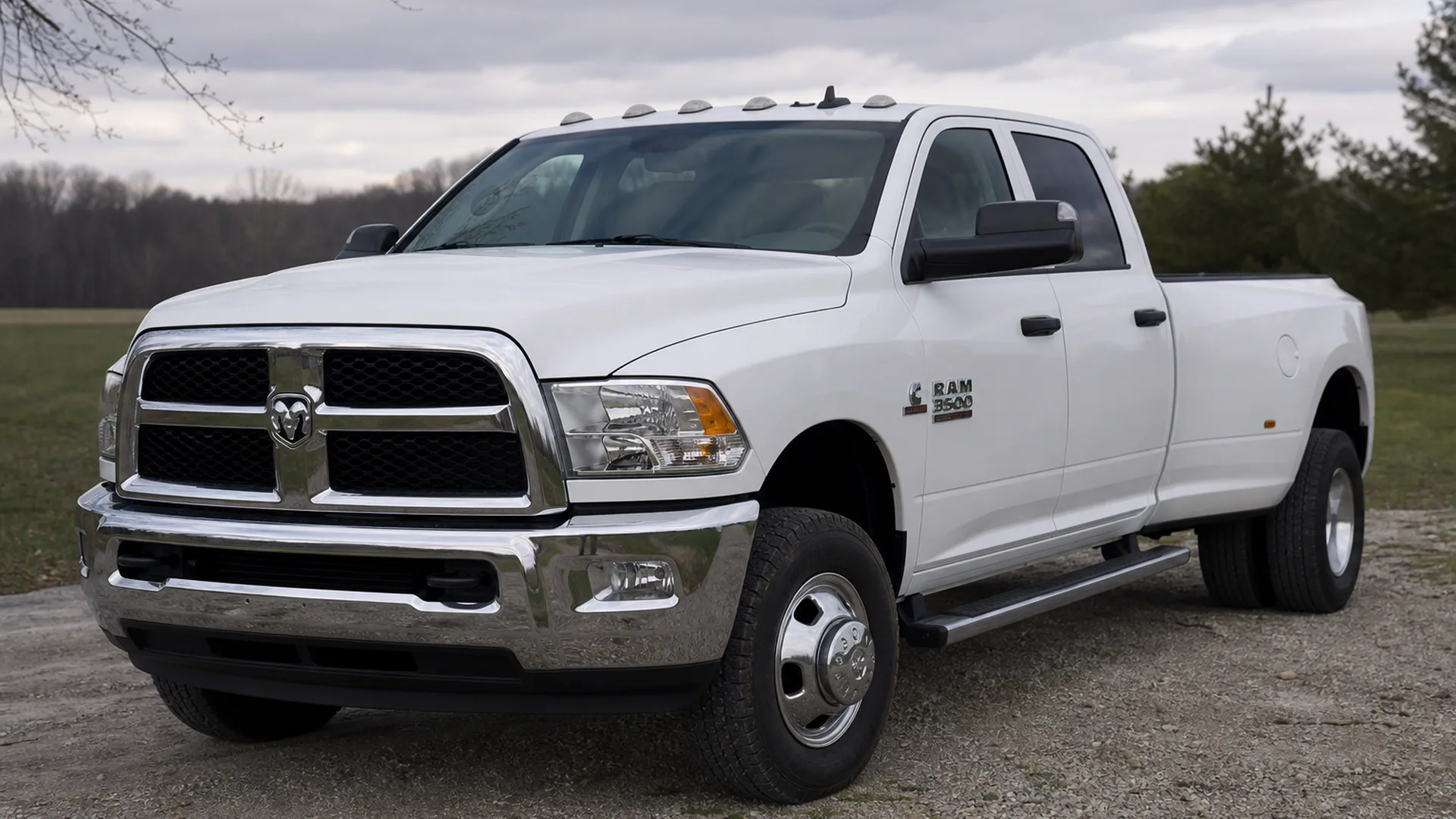
Shopping for a Ram 3500? You’re looking at one of the toughest heavy-duty pickups ever built—a truck that can tow over 35,000 pounds and haul serious payload thanks to the legendary Cummins turbo-diesel. But here’s the catch: some model years are riddled with safety recalls, chronic steering failures, and engine problems that’ll drain your bank account faster than the truck drains its DEF tank.
We’re breaking down exactly which Ram 3500 years you should walk away from, why they fail so often, and which years are actually worth your money. If you’re about to drop serious cash on a used HD truck, this guide could save you from years of frustration and repair bills.
How we rated the best and worst Ram 3500 years
We didn’t just skim a few reviews and call it research. Our team pulled data from:
- NHTSA complaint and recall databases – tracking every safety defect and owner-reported failure by year
- Owner forums (RamForum, CumminsForum, HD truck communities) – real stories from people who’ve lived with these trucks daily
- Transport Canada recall data – confirming cross-border issues affecting both U.S. and Canadian models
- Mechanic insights and repair frequency reports – identifying which failures show up most in the shop
We focused on safety-critical problems first—steering failures, engine shutdowns, brake malfunctions—then looked at costly repairs and widespread defects. The result? A clear picture of which years to avoid and which ones you can actually trust.
Most Common Ram 3500 Problems
Before we call out specific years, let’s talk about what actually goes wrong with these trucks. Some issues pop up across multiple generations, while others hit certain years harder than others.
1. Death Wobble and Steering Failures
This is the big one. “Death wobble” sounds dramatic, but owners who’ve experienced it will tell you the name fits. Picture this: you’re cruising at highway speed, hit a bump, and suddenly your truck’s front end starts shaking so violently you can barely hold the wheel. The only way to stop it? Slam on the brakes and slow to a crawl.
The 2012–2014 models saw the worst of it, but 2007 trucks weren’t far behind. Some 2007 owners reported tie rod ends literally popping off while driving, causing complete loss of steering. Ram issued multiple recalls covering over 573,000 trucks for faulty steering linkages, but many owners say the fixes didn’t solve the problem completely.
2. Engine Troubles That Stop You Dead
The Cummins diesel is normally bulletproof, but certain years had serious flaws. The 2013–2014 trucks suffered broken valve springs that led to catastrophic engine failure. Turbocharger actuator failures plagued 2013–2015 models—you’d be driving along when suddenly the truck would drop into “limp mode” and barely crawl at 10 MPH.
Then there’s the fuel pump disaster. Ram recalled about 222,000 of its 2019–2020 trucks because the Bosch CP4.2 high-pressure fuel pump could fail and send metal shards through the entire fuel system. This wasn’t just a U.S. problem—Canadian owners got hit too since it was a North America-wide recall.
More recently, 2019–2022 Cummins 6.7L engines developed a “lifter tick” problem where failing lifters cause excessive valvetrain wear. Not exactly what you want to hear when you just spent $70,000 on a truck.
3. Transmission and Drivetrain Headaches
Ram has used a few different transmissions over the years—the Chrysler 68RFE, the Aisin AS69RC, and a manual option (until 2018). The most common complaints? Hard shifting, slipping, and sudden deceleration into limp mode.
2015 trucks saw a rash of transmission service warnings, usually traced back to a bad gear shifter cable or sensor. Some 2022 models had Aisin transmission failures where snap rings broke and wiped out entire gear sets—requiring full transmission replacement.
Older Dodge-era trucks (like the 2005) had a scary problem where the truck could jump out of Park on its own. Ram even issued a recall for 2020–2022 models because transmission fluid could leak out the dipstick tube under pressure.
4. Electrical Gremlins
If there’s one thing that defines the troublesome Ram years, it’s electrical problems. The culprit? Often the TIPM (Totally Integrated Power Module)—a fancy name for the box that controls most of your truck’s electrical functions.
The 2006 Ram 3500 is notorious for HVAC failures traced to TIPM faults. Your A/C just stops working, or the heater quits in the middle of winter. Power windows, door locks, gauges—all can go haywire when the TIPM acts up.
2012 models had ignition switch problems that caused trucks to randomly shut off while driving, which also killed the power steering and brakes. Not ideal when you’re towing a 20,000-pound trailer.
Canadian owners in cold climates dealt with an extra issue: grid heater relay failures. Ram had to recall 2021–2023 diesels because the heater relay could short circuit and even cause fires.
5. Brake System and Safety Issues
Brake complaints are less common but still serious. Some 2018 Ram 3500s had ABS and stability control problems where warning lights would flash and occasionally affect brake function. Trailer brake controllers failed on 2012 models, leaving owners with no way to brake their trailers—a nightmare scenario when you’re hauling a heavy load down a mountain.
Ram also issued a tailgate latch recall for 2015–2018 trucks because tailgates could pop open while driving. Again, this affected both U.S. and Canadian models.
6. HVAC and Interior Quality
Early Dodge Ram 3500 trucks (2001–2003) had dashboards that would crack and literally fall apart. The 2003 model year had over 70 reports of cracked dashes alone—so common that owners petitioned for a recall.
Beyond that, 2006–2009 trucks had weak heating and A/C, often requiring replacement of blend door actuators or even the entire heater box. More recent models (2019–2020) had occasional climate control calibration issues, though these were usually fixed with software updates.
7. Tech Problems in Newer Models
As Ram added more technology, software bugs crept in. Uconnect infotainment systems froze or rebooted randomly in some 2019+ models. Ram issued a recall for 2022 trucks because the rearview camera could fail to display due to a software glitch.
Some 2021–2022 owners report digital instrument cluster issues or false warning messages, though dealer software updates usually fix these. Still, if you’re buying a newer used Ram 3500, make sure all software recalls have been performed.
The Worst Ram 3500 Years You Should Avoid Completely
Now for the main event—the model years that earned their spot on every “avoid” list for good reason.
2003: The Cracked Dashboard Nightmare
The 2003 Dodge Ram 3500 holds the title for highest complaint count of the Dodge era. This truck had a defective dashboard material that would crack and crumble into pieces, affecting hundreds of owners. While that sounds cosmetic, sharp broken dash pieces can be dangerous in a crash.
Beyond the dash, 2003 trucks had 15 recalls and typical third-generation Ram problems like front-end wear and occasional injection pump issues on the Cummins. Unless you find one that’s been fully restored and maintained to perfection, skip this year.
2006: Electrical and HVAC Chaos
The 2006 model racked up 464 complaints and 15 recalls. The biggest headache? A faulty A/C and heater system. Owners would suddenly lose all climate control, often traced to the TIPM or engine computer. Fixing it meant replacing expensive electrical modules or the entire AC compressor.
The 2006 was also part of Chrysler’s TIPM-related electrical problems that could affect everything from wipers to fuel pumps. While the Cummins engine itself was solid, the avalanche of electrical issues makes this a hard pass for most buyers.
2007: Steering Failures and Safety Recalls
Although complaints dropped slightly in 2007, this year had an alarming 18 recalls—one of the highest counts ever for the Ram 3500. The main problem? Steering and suspension failures.
Owners reported tie rod ends breaking and severe death wobble episodes. Some wobble incidents were so violent they damaged suspension components and tires. Chrysler issued recalls to address these defects, but many owners still experienced problems even after the recall fixes. Given the safety risk, 2007 (especially 4×4 models) is a year to avoid.
2012: Death Wobble Returns
The early Ram-branded years were rough. 2012 logged 43 complaints—the most of any Ram-branded 3500—and serious problems across the board. Death wobble came roaring back, with owners describing terrifying shakes at highway speeds that only stopped if you braked to a full stop.
Electrical problems were just as bad. Trucks would randomly shut off due to ignition or key fob issues, and trailer brake controllers would fail unexpectedly. When your truck shuts off while driving, you lose power steering and brakes—not something you want happening in traffic or while towing.
2012 was the last year before Ram updated the HD trucks with a new frame and suspension, so it missed out on later improvements. Skip this year.
2013: The Worst Modern Ram 3500
Several sources name 2013 as the absolute worst year for the modern Ram 3500. It received 18 recalls and over 200 complaints. The big issue? Engine reliability.
2013 introduced a new high-output Cummins with additional emissions hardware, and many engines suffered broken valve springs, turbo failures, and constant check-engine lights. Repairs were expensive and often needed repeating. Death wobble continued to plague these trucks too.
If you’re shopping used, 2013 is the year to avoid above all others in the 2010s.
2014: Turbo Failures and Continued Problems
The 2014 model kept the bad streak going with 293 complaints and 17 recalls. The notorious failure here? Turbo actuators that would die suddenly while driving, causing immediate power loss and limiting the truck to idle speed.
Replacing a turbo actuator (or the entire turbo) isn’t cheap, and some owners dealt with multiple failures. Between engine concerns, electrical gremlins, and suspension complaints, 2014 is only marginally better than 2013—which means it’s still pretty bad.
2015: Limp Mode and Drivetrain Troubles
The 2015 Ram 3500 shows up on “avoid” lists less often than 2013–2014, but it still had significant problems. Owners encountered sudden deceleration into limp mode due to turbocharger actuator failures (yes, still happening in 2015).
Transmission warnings and erratic shifting were common, usually traced to bad shift linkage or sensors. While not as infamous as its predecessors, the 2015 still has enough costly issues and double-digit recalls to make it a risky buy.
2016: Wheels Literally Falling Off
The 2016 Ram 3500 was the last of the fourth-generation HD Rams, and it went out with a bang—or more accurately, a wheel flying off.
There were multiple reports of wheel studs snapping off and wheels detaching from nearly-new 2016 trucks. All eight studs on a rear dual wheel could shear off, sending the wheel flying down the road. That’s not just inconvenient—it’s deadly.
Vibration and tire problems were common too, with some owners seeing tire tread separations at low mileage. These wheel and tire failures led to accidents and even vehicle fires in some cases. Ram worked out most bugs by 2017, making 2016 the last truly “bad” year before major improvements.
What About 2019?
The 2019 Ram 3500 was the first year of the current fifth-generation design. It had the fuel pump recall we mentioned earlier and more complaints than any other 5th-gen year. Some sources recommend sticking with 2020 and newer if you want the latest body style.
Very early 2000s trucks (2000–2002) and 2005 also had moderate issues—like occasional engine stalls and “jumping out of park” incidents—but the years above represent the most problematic models widely recognized by owners and experts.
The Best Ram 3500 Years You Can Actually Trust
Not all Ram 3500s are troublemakers. Some model years proved reliable, durable, and worthy of their reputation.
2004: Old-School Reliable
Looking at older trucks? The 2004 Dodge Ram 3500 is often cited as a solid pick. By 2004, Ram had addressed the worst bugs from 2003, and it still featured the legendary 5.9L Cummins diesel with fewer emissions controls.
Owners report these engines lasting well beyond 400,000 miles with proper maintenance. The truck has excellent towing capacity for its era and a simpler design with fewer electronics to fail. While it’s not perfect (dashboards can still crack, front ends wear), it avoids the worst problems of surrounding years.
2011: The Overlooked Winner
The 2011 Ram 3500 doesn’t get much attention, but it’s a solid truck. It logged only 22 complaints compared to 2012’s 43. The 2011 still has the fourth-gen platform and 6.7L Cummins without Selective Catalytic Reduction (meaning more frequent regens but a proven powertrain).
Most of the severe death wobble and electrical issues hit 2012 models, so 2010–2011 trucks largely avoided those problems. If you find a well-maintained 2011, it could be a smart buy for heavy towing use.
2017: The Reliability Turnaround
Many experts consider 2017 a turning point for Ram HD reliability. By this year, Ram had refined the truck and fixed most of the early 2010s problems. Owner satisfaction is high, and trucks from this year tend to run for years without major issues.
Complaints dropped significantly—2016 had 23, but 2017 had only 16. The 2017s use the proven 6.7L Cummins (385 hp / 900 lb-ft) with the available Aisin transmission, plus improved front-end components to reduce wobble and a refined DEF emissions system.
If you want a used fourth-gen Ram 3500, 2017 is one of the best years to target for capability and reliability.
2018–2020: Modern and Trustworthy
Late fourth-gen and early fifth-gen Ram 3500s showed major reliability improvements. The 2018 model continued the positive trend from 2017. While there was a known ABS/traction control issue, it was resolved and didn’t affect many trucks.
Moving to the fifth generation, 2019 had that fuel pump recall and higher complaints, but 2020 and newer have been rock-solid. According to complaint databases, 2020–2021 Rams have virtually no reported problems (only three complaints each).
By 2020, Ram switched back to the reliable CP3 fuel pump and refined the new body and electronics. These later models offer the most modern technology and highest performance—like the 2021 high-output Cummins with 1,075 lb-ft of torque.
If your budget allows, a 2020 or 2021 Ram 3500 (U.S. or Canadian market) would be an excellent choice with far fewer known issues than the problematic years.
Pro tip: Even for these “best” years, confirm that all open recalls have been completed—like the 2018 brake/ABS recall or the 2019/2020 fuel pump recall. Get a full service history and pre-purchase inspection to verify the truck is in good shape.
Better Alternatives If Ram’s Issues Worry You
If the Ram 3500’s troubled history has you second-guessing, consider these heavy-duty alternatives. Each has its own strengths and weaknesses across different model years.
Ford F-350 Super Duty: Built Ford Tough (Mostly)
Ford’s one-ton truck has a strong reputation for long-term dependability. That said, you’ll want to avoid certain years—like the 2003–2007 models with the problematic 6.0L Powerstroke, or 2008 with the even worse 6.4L Powerstroke.
Ford turned things around with the 6.7L Power Stroke V8 in 2011. The 2015–2016 F-350s are particularly reliable, with low complaint counts and most bugs worked out. In the newer aluminum-bodied generation (2017+), Ford had some early hiccups but hit its stride by 2020–2022.
If you’re considering a used truck, a 2015 or 2016 F-350 makes a great alternative. For newer models, 2020+ F-350s have stellar reliability and class-leading capabilities. Ford also offers strong gas engine options (like the 7.3L “Godzilla” V8) if you want to skip diesel complexity.
Chevy Silverado 3500HD / GMC Sierra 3500HD: Smooth Operators
GM’s heavy-duty twins are known for comfortable rides and strong Duramax diesel engines. Like Ram and Ford, certain years are better than others.
Avoid early 2000s models with injector issues and especially 2012–2013 GM 3500s (2012 is flagged as the worst year with dashboard cracking, brake failures, and electrical problems).
GM made major improvements by the mid-2010s. They eliminated the risky CP4 fuel pump after 2016 and introduced the robust L5P Duramax diesel in 2017. Enthusiasts often cite 2017–2019 models as very solid years—these trucks have the L5P engine (445 hp / 910 lb-ft) without fuel pump failures and a proven six-speed Allison transmission.
For an alternative to a 2013–2016 Ram, consider a 2017–2019 Silverado or Sierra 3500HD. According to Duramax forums, 2019 was the pinnacle of that generation with fewer recalls and late-production refinements.
Final Verdict: Choose Wisely or Pay Later
Here’s what you need to remember: avoid 2003, 2006–2007, 2012–2014, and 2016 Ram 3500s without exception. Be cautious with 2015 and 2019. Your safest bets are 2017–2018 and 2020+.
Steering and suspension issues are the biggest long-term risk with Ram 3500s. When you’re looking at used trucks, prioritize safety and reliability over raw torque numbers. Never buy a Ram 3500 with unresolved steering recalls—the risk isn’t worth any price.
Sometimes spending a bit more for a newer year or considering an alternative brand saves you thousands in repairs and keeps you safe on the road. A powerful truck means nothing if it can’t drive straight, stay running, or keep its wheels attached.
Choose the right Ram 3500 year, and you’ll have a dependable workhorse that can handle anything you throw at it. Choose the wrong year, and you’ll be on a first-name basis with your mechanic—and not in a good way.