
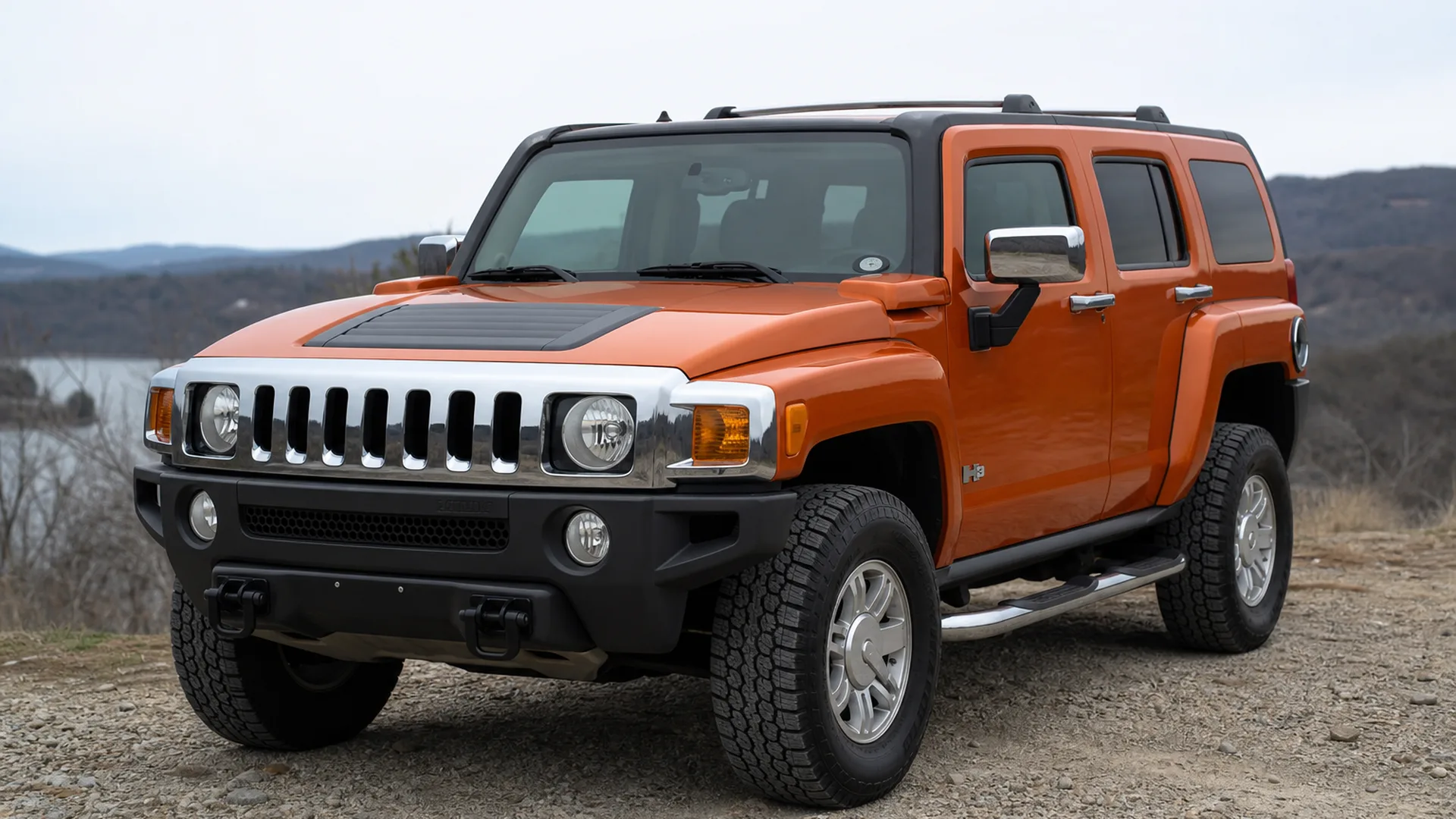
The Hummer H3 arrived in 2006 with a promise: military-grade toughness wrapped in a package regular folks could actually park. It looked ready to conquer everything from mountain passes to mall parking lots. With a body-on-frame design, serious 4WD hardware, and that unmistakable Hummer presence, the H3 seemed like the perfect compromise between the giant H2 and practical daily driving.
But here’s the reality check – early H3s brought more headaches than highway miles. From burnt valves that left engines coughing at 80,000 miles to electrical gremlins that could strand you in a parking lot, certain model years turned ownership into an expensive gamble. This guide breaks down exactly which H3 years you should skip, which ones are worth considering, and what alternatives might save you thousands in repair bills.
How We Researched the H3’s Reliability Record
Our team pulled data from multiple angles to give you the full picture. We combed through NHTSA complaint databases (where real owners report serious problems), analyzed recall bulletins from GM, and tracked repair patterns on CarComplaints.com across all five model years. We also dug into forum discussions on HummerXClub and Reddit’s automotive communities, where owners share the unfiltered truth about what actually breaks.
We cross-referenced professional reviews from sources like J.D. Power and RepairPal with real-world ownership costs reported by mechanics and H3 enthusiasts. Every claim about engine failures, transmission rebuilds, or electrical faults is backed by documented cases – not rumors or guesswork. When we say a 2006 H3 has cylinder head issues, we’re pointing to hundreds of owner reports and the specific GM service bulletins that addressed them in later years.
For repair costs, we used a combination of dealership estimates, independent shop quotes, and parts pricing from RockAuto and AutoZone. The result? A clear picture of which years cost the most to own and which ones actually deliver on the H3’s rugged promise.
The H3’s Most Persistent Problems Across All Years
1. Engine Trouble: The Valve Seat Nightmare
The biggest single issue plaguing early H3s comes down to faulty cylinder heads on the 3.5L inline-five engine. Owners of 2006 models especially reported rough idling, misfires, and significant power loss once their trucks hit 80,000–90,000 miles. The root cause? Worn valve seats that allowed combustion gases to leak past the valves, creating low compression and burnt valves over time.
Here’s what made this frustrating: you might replace spark plugs and ignition coils thinking you’d solved the misfire, only to find the rough running persisted. Eventually, a compression test would reveal the truth – you needed a full cylinder head replacement or valve job costing anywhere from $2,500 to $3,500. Many owners discovered their H3 was burning oil by the quart between changes, another telltale sign the head was compromised.
GM quietly addressed this in 2007 by upgrading to a 3.7L five-cylinder with improved valve seat design, but that left 2006 buyers holding the bag. Any used H3 from that first year should come with proof the head was replaced or show pristine compression numbers across all five cylinders.
2. Cooling System Failures and HVAC Fire Hazards
Radiators on 2008 H3s developed an annoying habit of cracking and leaking coolant, often just after the warranty expired. The fix wasn’t terribly expensive – a new radiator runs $100–$750 depending on quality – but catching it late could lead to overheating and warped heads (piling one expensive repair onto another).
The more serious issue involved the HVAC system. GM’s wiring harness for the blower motor would overheat during extended high-speed fan use, melting the connector and sometimes sparking small fires behind the dashboard. This wasn’t a “maybe” problem – it triggered a **safety recal**l covering every single 2006–2010 H3. Owners reported the blower cutting out entirely around 90,000 miles, leaving them without heat in winter or A/C in summer until the harness was replaced.
Even after the recall fix, some older H3s saw blower motor failures at 120,000+ miles, requiring a $200–$400 replacement to restore climate control. The lesson? Make absolutely certain any H3 you’re considering has had the blower motor harness recall completed. Check the VIN with a dealer or use NHTSA’s recall lookup tool.
3. Electrical Gremlins: Fuel Gauges and the Passlock Fiasco
Ask any 2006 H3 owner about the Passlock anti-theft system and watch them wince. This GM security feature became infamous for malfunctioning and refusing to let the engine start. You’d turn the key, see the “Service Theft System” light illuminate, and sit there stranded while the system decided your key wasn’t authorized. The fix often required replacing ignition switch components or reprogramming the body control module – work that could run $300–$800.
Meanwhile, faulty fuel level sensors (especially in 2006–2008 models) caused fuel gauges to swing wildly or drop to empty despite a full tank. The only reliable fix was replacing the entire fuel pump module since the sensor is integrated into that assembly. Count on $400–$600 for parts and labor.
Smaller annoyances piled up too: power window regulators that failed without warning, dashboard warning lights triggered by something as simple as a loose gas cap, and batteries that drained prematurely due to parasitic draws. None of these individually bankrupted owners, but together they painted a picture of an SUV with frustratingly inconsistent electrical quality.
4. Transmission Shudders and Drivetrain Weak Points
The four-speed automatic transmission in the H3 generally held up better than the engine, but high-mileage examples (particularly 2007 models) showed their age around 120,000 miles. Symptoms included harsh shifting, shuddering between gears, and in worst cases, complete failure to engage certain gears. Rebuilding or replacing the transmission ran $1,000–$3000 depending on whether you chose a used unit or a full rebuild.
The transfer case had its own quirk: early models used a plastic shift fork that could snap, leaving the truck stuck in four-wheel-drive high or low. You’d hear grinding noises when trying to shift between 2WD and 4WD, and eventually the mechanism would jam completely. GM switched to a metal fork in later production runs, but 2006–2007 trucks with this component might face a $800–$1,200 repair if the fork breaks and damages other transfer case internals.
5. Suspension and Frame Integrity Concerns
The H3’s ladder frame should’ve been bombproof – and in dry climates, it mostly was. But rust-belt examples from the Northeast and Midwest revealed a disturbing pattern of frame corrosion on early models. Some 2006 H3s developed rust-through in critical frame sections, compromising structural safety. Repairing or replacing a frame runs $10,000+ if it’s even feasible, effectively totaling most older H3s.
Rear leaf springs also had a habit of breaking suddenly on 2006–2008 models. One owner reported both rear springs snapping during normal highway driving, which caused the driveshaft to separate and damaged the fuel tank mounting straps. GM issued a technical service bulletin about leaf spring squeaks and retaining clips for 2007–2010 models, but oddly left 2006 out of that coverage. If you’re looking at an early H3, crawl underneath and inspect those leaf springs for cracks or severe corrosion.
Less dramatically, expect typical wear in ball joints, control arm bushings, and shocks as these trucks age past 100,000 miles. Some owners also reported a front-end shake or wobble at highway speeds – usually traced to worn steering components or badly worn tires, both fixable with routine maintenance.
The Absolute Worst H3 Years You Should Walk Away From
2006: A Debut Year Disaster
If there’s one H3 model year that deserves a skull-and-crossbones warning, it’s 2006. This first-year model racked up more owner complaints than all other years combined. The cylinder head valve seat failure we mentioned? That’s overwhelmingly a 2006 problem. Hundreds of owners watched their H3s develop misfires, burn oil by the quart, and ultimately need $3,500 head jobs before hitting 100,000 miles.
Add in the Passlock no-start issue that stranded countless drivers, water leaks through poorly sealed body panels, and an assortment of squeaks and rattles that pointed to rushed assembly, and you’ve got a vehicle that tested the patience of even die-hard Hummer fans. Even on enthusiast forums where owners normally defend their vehicles, the consensus is clear: 2006 H3s were plagued with issues GM later quietly fixed.
Unless you find a 2006 with documented proof of a complete engine rebuild, new cylinder heads, and every recall completed, keep walking. The risk of inheriting someone else’s expensive mechanical nightmare is just too high.
2007: Better, But Still Risky
GM made real improvements for 2007, most importantly swapping the problematic 3.5L engine for a revised 3.7L five-cylinder that solved the valve seat failures. That’s the good news. The bad news? CarComplaints data shows 2007 still logged the second-highest complaint count of any H3 year.
Owners began reporting transmission issues around 100,000–130,000 miles – rough shifts, shuddering, and in some cases complete transmission failure requiring $1,600 rebuilds. Cooling system problems persisted too, with radiators cracking and thermostats failing at frustrating rates. And the same electrical quirks that plagued 2006 models – EVAP system faults, random warning lights, fuel gauge problems – continued into 2007.
A 2007 H3 isn’t the worst option if you find one with detailed maintenance records showing the radiator was replaced, the transmission serviced regularly, and all recalls completed. But it’s still not the year we’d recommend when better options exist.
2008: The Year of the Burning Blower Motor
The 2008 H3 brought something exciting: the optional Alpha package with a 5.3L V8 that finally gave the H3 adequate power. Unfortunately, 2008 also became notorious for two specific problems that make it a questionable buy.
First, the HVAC blower motor harness failures peaked in 2008 before the recall fix became widespread. Owners reported losing climate control multiple times, and in a few scary cases, smelling smoke or seeing small fires behind the dash as the harness melted. Even after GM issued the recall, early-build 2008s that hadn’t received the fix remained fire hazards sitting in driveways.
Second, radiator failures hit 2008 models especially hard. So many owners experienced cracked radiators that they joked about keeping spare coolant in the cargo area. Replacing the radiator wasn’t outrageously expensive, but doing it multiple times got old fast.
If you’re considering a 2008 H3 – particularly an Alpha with that desirable V8 – verify the blower motor harness recall was completed and ask for documentation showing the radiator was replaced with an improved unit. Without proof of those fixes, an ’08 remains a gamble.
The Best H3 Years: When GM Finally Got It Right
2010: The Crown Jewel of Reliability
By the time 2010 rolled around, Hummer had only months left before GM shut down the brand entirely. But that final model year represents the most refined, reliable H3 you can buy. CarComplaints lists zero owner complaints for 2010 models – a stunning contrast to the dozens filed against 2006–2008 trucks.
GM had addressed every major weakness by this point. The 5.3L V8 option (standard on Alpha models) eliminated any lingering concerns about the inline-five’s durability, delivering proven small-block reliability that could run 200,000+ miles with proper maintenance. All factory recalls and running changes had been implemented, meaning the blower motor harness was upgraded from the start and the hood louver was properly secured.
J.D. Power gave the 2010 H3 a middle-of-the-road 3 out of 5 reliability rating, but real-world owner experiences suggest that’s conservative. Long-term owners report only routine maintenance needs – oil changes, brake pads, the occasional sensor – rather than the expensive mechanical failures that plagued earlier years.
The downside? 2010 production was extremely limited, making these rare finds on the used market. When you do locate one, expect to pay a premium. But if you want an H3 that delivers on the brand’s capability promise without constant trips to the mechanic, a 2010 is worth the extra search effort and cost.
2009: Nearly Perfect and More Available
A 2009 H3 offers virtually all the benefits of a 2010 but with slightly better availability since production numbers were higher that year. By 2009, the engine head problems were ancient history, complaint counts had dropped to single digits, and GM had implemented the key reliability improvements that made later H3s trustworthy.
The Alpha V8 was available throughout the 2009 model year, giving you access to that power upgrade without the early-year teething problems. Owners report generally positive experiences, with most issues being minor annoyances like a window regulator failing or a stray dashboard warning light rather than catastrophic mechanical failures.
The one thing to verify on a 2009: make sure the fuel tank support strap recall was completed. That recall affected some 2009 VINs and could result in a fuel tank dropping if both straps failed – a rare but serious safety hazard. As long as that’s been addressed, a 2009 H3 represents solid value in the used market.
Late 2008 and the H3T Pickup
If you can’t find a 2009 or 2010 in your budget, a late-build 2008 – especially an Alpha model – can work as a compromise. By the end of 2008 production, many of the HVAC and radiator issues had been addressed through running changes or were being fixed immediately by dealers once the recall was announced. An Alpha’s beefier transmission and V8 power make it noticeably more capable than earlier five-cylinder trucks.
Worth mentioning separately: the H3T pickup truck variant sold only in 2009 and 2010. Mechanically identical to the SUV version, the H3T benefits from the same late-year improvements. Because fewer were made and they cost more when new, many H3Ts were well-optioned and carefully maintained by their original owners. If you find one in good shape, it’s as solid a choice as a comparable H3 SUV with the added utility of an open bed.
Better Alternatives: When You Should Just Skip the H3
Toyota 4Runner: The Reliability Champion
If the Hummer H3 appeals to you but the reliability concerns are a dealbreaker, the Toyota 4Runner should be your first alternative. This body-on-frame SUV matches the H3’s off-road capability but absolutely crushes it in dependability. Fourth-generation 4Runners (2003–2009) and fifth-generation models (2010–present) routinely surpass 200,000 miles without major repairs.
The 2009 4Runner, for example, holds a RepairPal reliability score of 4.0 out of 5 – far better than any H3 year. Toyota’s 4.0L V6 engine, five-speed automatic transmission, and 4WD components are engineered for longevity rather than cost-cutting. Owners report that beyond standard maintenance like brake pads and timing belts, their 4Runners simply don’t break.
Off-road, a 4Runner trades punches with an H3. You get similar ground clearance, approach and departure angles that handle serious trails, and options like locking differentials or Toyota’s A-TRAC traction control system. The difference? When you get home from that trail run, the 4Runner will start reliably on Monday morning and won’t need a cylinder head replacement at 85,000 miles.
For specific years, look at 2004–2006 models in the fourth generation (extremely few issues reported) or 2010–2013 in the fifth generation (equally solid track record). The main downside? 4Runners hold their value ruthlessly well because everyone knows they’re bulletproof. You’ll pay more upfront but save thousands in repair costs over the long haul.
Toyota FJ Cruiser: Hummer Style, Toyota Substance
The Toyota FJ offers the closest thing to an H3 experience from a reliability standpoint. You get retro styling that turns heads, body-on-frame construction, and serious trail capability – all backed by Toyota’s reputation for building SUVs that refuse to die.
Under the hood sits the same 4.0L V6 and transmission setup used in the 4Runner, meaning you inherit that engine’s stellar reliability record. FJ owners routinely report 150,000+ miles with zero major mechanical problems, just routine oil changes and brake jobs. Some early models (2007–2008) had minor issues like cracking inner fender liners on heavily off-roaded trucks, but these are fixable with reinforcement kits and pale compared to the H3’s cylinder head failures.
For the most refined FJ experience, target 2010–2014 models. Toyota added dual VVT-i to the engine in 2010, providing more power and slightly better fuel economy. These later FJs also benefit from several years of running improvements that addressed any early quirks.
The reality check? FJ Cruisers were discontinued after 2014, and their reputation for reliability has made them highly sought-after in the used market. Expect to pay premium prices compared to an equivalent H3. But you’re paying for peace of mind – an FJ will almost certainly outlast any H3 that isn’t a pristine 2010 model.
Nissan Xterra: The Budget-Friendly Trail Runner
The second-generation Nissan Xterra (2005–2015) deserves consideration if you want H3-style adventure capability without Toyota-level pricing. Here’s the catch: you need to focus on 2011 or newer models to avoid two significant early defects.
Pre-2011 Xterras had a radiator design flaw that could allow coolant to leak into the transmission – a problem that could destroy the transmission if not caught early. They also suffered from timing chain tensioner wear on the 4.0L V6 engine. Nissan corrected both issues by 2011, making later Xterras far more reliable.
The 2013 Nissan Xterra, for instance, shows just two complaints and zero recalls on CarComplaints – an enviably clean record. The VQ40 V6 engine in these later trucks is strong (261 hp) and durable when properly maintained. PRO-4X models came with electronic locking rear differentials, skid plates, and Bilstein shocks, creating a very capable off-road package.
Xterras have a more utilitarian interior than a 4Runner or H3, but they’re designed to be hosed out and abused. Common repair costs are reasonable since there are no expensive chronic failure modes once the radiator issue was resolved. If you’re shopping Xterras, stick to 2011–2015 models, or verify that an earlier truck had the radiator replaced or bypassed to prevent transmission contamination.
Jeep Wrangler: The Aftermarket King
No alternative list would be complete without mentioning the Jeep Wrangler – the H3’s most direct competitor in terms of off-road heritage and aftermarket support. The Wrangler offers simpler mechanics than an H3, better fuel economy, and the most extensive collection of aftermarket parts and modifications in the entire SUV world.
Reliability is more mixed here than with Toyota products. The 2007–2011 JK Wranglers with the 3.8L V6 were known for oil consumption and occasional gasket leaks. The 2012–2013 models that received the new 3.6L Pentastar V6 faced some early cylinder head problems, though most were resolved under warranty.
By 2015, Jeep had sorted most of these issues. A 2015–2018 JK Wrangler or anything from the current JL generation (2018+) represents a much safer reliability bet. Most complaints in these later years involve minor electronics or cosmetic issues rather than major mechanical failures.
The Wrangler’s biggest advantage over an H3? Parts availability and cost. Because millions of Wranglers roam the roads, both OEM and aftermarket parts are cheap and plentiful. Even when something breaks, fixing it won’t require hunting for rare Hummer-specific components or paying premium prices. That said, Wranglers have their own quirks – death wobble steering issues if suspension components wear, water leaks around removable tops, and general need for regular maintenance.
A Wrangler won’t match Toyota reliability, but the massive community support and easy repairs make ownership less stressful than an early H3.
Lexus GX: When Money Isn’t the Issue
For buyers with larger budgets who want bombproof reliability paired with luxury, the Lexus GX 470 (2003–2009) and GX 460 (2010–present) deserve consideration. These are essentially upscale versions of the Toyota Land Cruiser Prado, featuring body-on-frame construction, full-time 4WD with locking center differentials, and legendary durability.
The GX 460 was rated the most reliable new vehicle in America by Consumer Reports in 2021, earning a perfect 100/100 reliability score. Many GX 470 owners report 200,000–300,000 miles with only routine maintenance like oil changes, brake work, and the scheduled timing belt replacement every 90,000 miles.
Off-road capability is serious – newer GX models even offer kinetic dynamic suspension systems (KDSS) that allow for better wheel articulation on trails while maintaining on-road composure. The tradeoff? These were expensive when new (often $50k+) and still command high used prices. You’re also getting far more luxury features than you probably need for trail duty.
But if you want an SUV that combines H3-level capability with best-in-class reliability and can afford the entry price, a GX 470 or 460 delivers peace of mind no H3 can match.
The Bottom Line: Should You Buy a Hummer H3?
The honest answer depends on which year you’re considering and what you expect from ownership. A 2010 or 2009 H3, particularly an Alpha model with the 5.3L V8, can be a solid choice for someone who wants that distinctive Hummer style paired with genuine off-road capability. These late-model H3s benefited from years of fixes and delivered the capability GM always promised.
But 2006–2007 H3s remain risky propositions even at bargain prices. The cylinder head issues alone make them potential money pits, and that’s before accounting for electrical problems, cooling system failures, and transmission concerns. A cheap 2006 H3 can quickly become expensive once you’re facing a $3,500 engine repair or multiple electrical gremlins.
If you’re dead-set on H3 ownership, follow these guidelines: prioritize 2009–2010 models with complete service records, verify all recalls have been completed, and budget $1,500–$2,000 annually for maintenance and repairs beyond just oil changes. Choose examples from dry climates to avoid frame rust, and strongly consider Alpha models for their more reliable V8 powertrains.
Otherwise, seriously consider the alternatives we’ve outlined. A Toyota 4Runner or FJ Cruiser will cost more upfront but save you thousands in repair costs and worry. A post-2011 Nissan Xterra offers H3-style adventure at a fraction of the price. A late-model Jeep Wrangler gives you incredible aftermarket support even when things do break. And a Lexus GX provides luxury and reliability that makes the H3 look like a science experiment in how many ways a truck can malfunction.
The H3 had promise – and in its final years, GM finally delivered on that promise. But unless you find one of those rare, well-maintained late-model examples, you’re better off spending your money on an SUV that’ll actually get you to the trails without leaving you stranded in the parking lot.